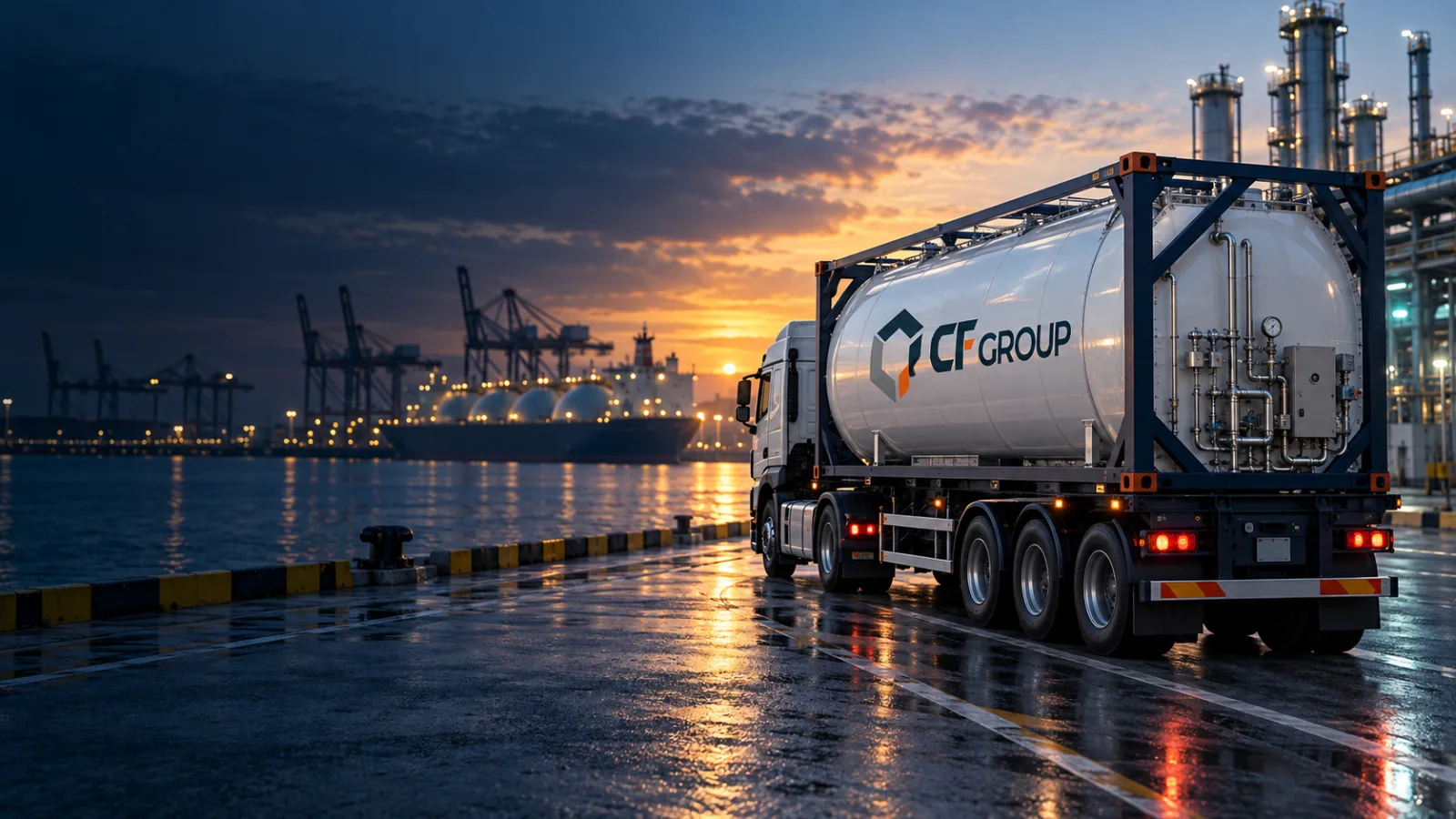
Many plans for shipping LNG North–South stop at a freight-rate spreadsheet. Whether the route actually runs is decided at the two ports: who lifts the tank onto the ship, under which procedure, and who is responsible when a tank builds pressure on deck.
LNG ISO tanks are class 2.1 dangerous goods
Under the IMDG Code, LNG in ISO tanks must be stowed on deck, segregated from other cargo, with pressure monitoring and a declaration before loading. That means the port needs suitable lifting equipment, operators who understand cryogenic cargo, and a procedure accepted by both the port and the shipping line. This is the port operator's job, not the job of whoever books space on the ship.
Long River — the port link inside CF Group
Long River is the CF Group member that installs, repairs and operates port handling equipment: quay cranes, gantry cranes, wheel loaders, conveyors, forklifts. According to its profile on cfg.vn it has more than 10 years' experience, more than 400 staff, and has operated bulk terminals receiving ships up to 300,000 DWT as well as container terminals.
For CF Energy this means the ISO LNG handling procedure is designed with the people who actually operate the cranes at both Cai Mep and Hai Phong — not through three layers of subcontractors. When a pressure incident happens in the yard, the person handling it was trained to the same HSSE standard as the tank operating team.
Why this is hard to copy
- Port operating capability cannot be bought with a short contract; it is people and accumulated machine hours.
- The IMDG 2.1 procedure for ISO LNG has to be approved separately by each port and each feeder line — a company already at the port moves faster than one applying from outside.
- One HSSE team covering the port yard, the depot and the truck fleet means responsibility does not fall into the gap between contractors.
Does the company offering you a sea route have a named crane operator at both ports? If not, the route is still on paper.