


Producers & cargo owners
Produce, import and own the cargo.
CF Energy organises transport, mobile storage and technical operations for LNG, LPG and CNG — from import terminal or mother station to the factory gate, by road, sea and rail. We do not trade gas. We do not compete with cargo owners.
CF Energy operates the logistics infrastructure for liquefied gas — from terminal and mother station to the plant gate. No gas trading.
LNG · LPG · CNG · ISO tank · satellite storage · bunkeringPick the need closest to yours. The form opens on the right service group so both sides can talk in operating figures from the start.
ISO T75 transport, storage and regasification skid at the point of use.
OPEN TECHNICAL BRIEF →02 / EQUIPMENTEquipment configured by product, volume and swap cycle.
OPEN TECHNICAL BRIEF →03 / OPERATIONSTank level, equipment status, maintenance and swap scheduling.
OPEN TECHNICAL BRIEF →04 / LPG · CNGT50 bulk LPG station or CNG tube trailers swapped on schedule, where there is no pipeline.
OPEN TECHNICAL BRIEF →We do not trade gas and do not compete with cargo owners. CF Energy's job is the middle leg: moving gas and industrial liquids from terminal to plant safely, to standard and on time.
Produce, import and own the cargo.
ISO tanks, satellite tanks, regas skids, depots, engineering and operating data.
Receive a stable supply at the point of use.
One tractor fleet, one depot network and one GasTwin™ platform for all three gases. Safety procedures are kept separate, because each gas behaves differently: cryogenic, pressure-liquefied, compressed.
 LNGFlow™CORE
Cryogenic ISO T75, regas skid at the plant; road, sea and rail; satellite tanks for large users.
↗ GasFlow™LPG
ISO T50 and bulk LPG stations at the plant on a fee-based operating model; cross-border ISO export by road.
↗ GasFlow™CNG
200–250 bar tube trailers from mother station to customer station; trailer swap scheduled from telemetry, for plants without a pipeline.
↗Depot, chassis and cleaning infrastructure are also shared with chemical ISO tanks (ChemFlow™) and food-grade liquids (FoodFlow™) — not CF Energy’s commercial focus.
The same ISO T75 travels by truck, ship and rail wagon, so cargo is never transferred en route. CF Energy picks road, sea or rail — or combines them — by distance, volume and how urgent each delivery is.
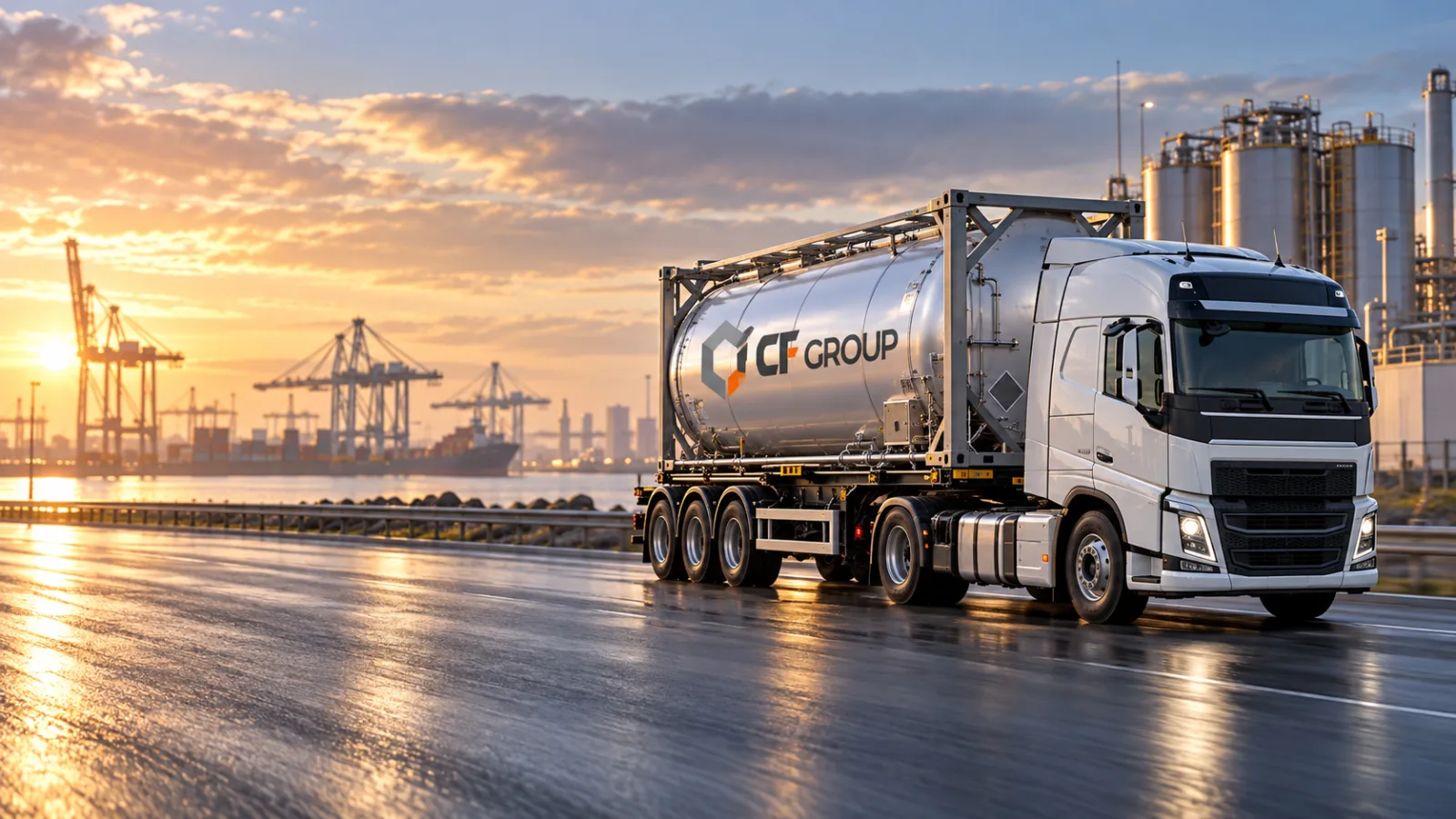
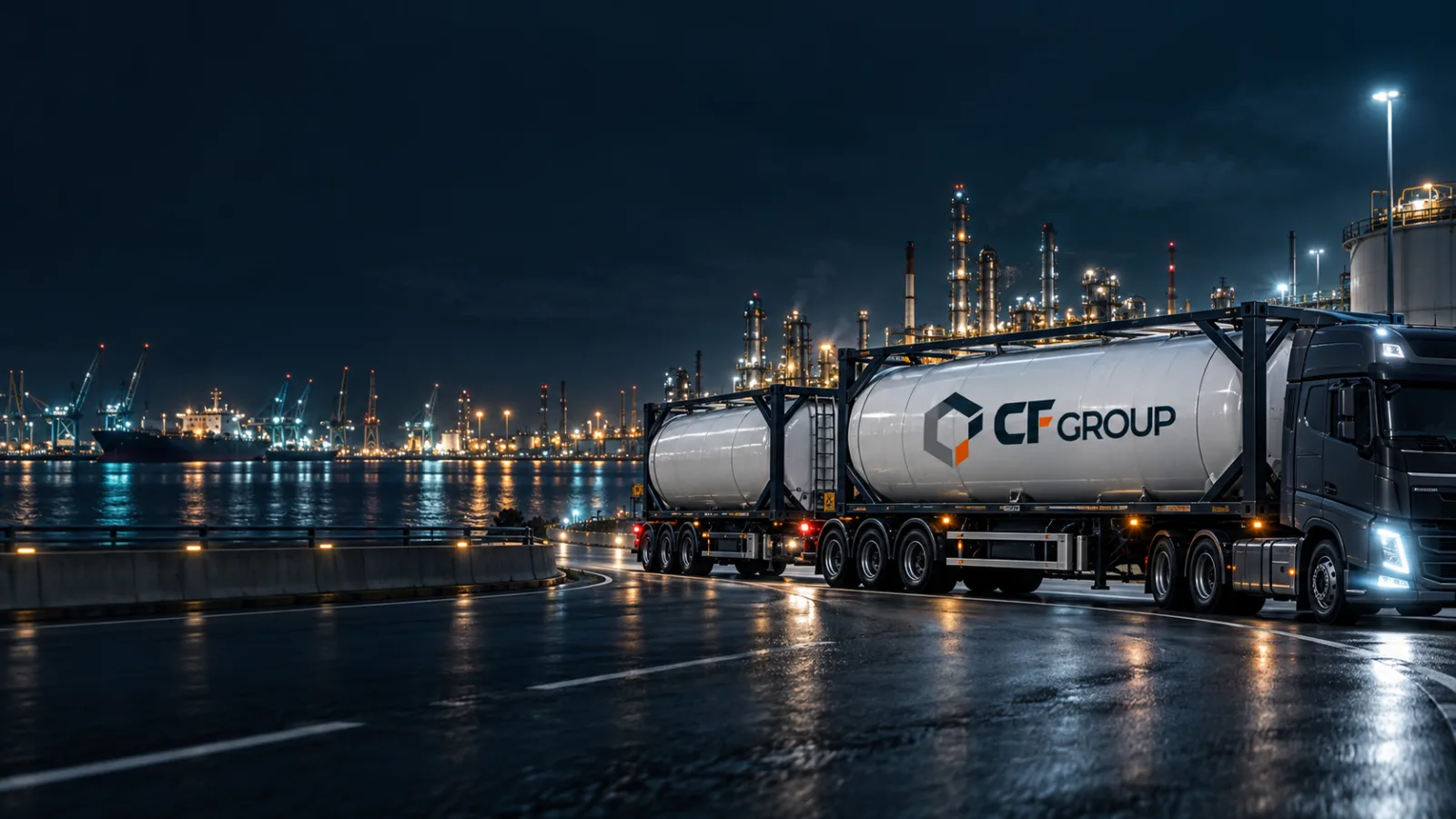
Tractor units and dedicated chassis carry ISO T75s from terminal or depot to the factory gate within each hub’s service radius.
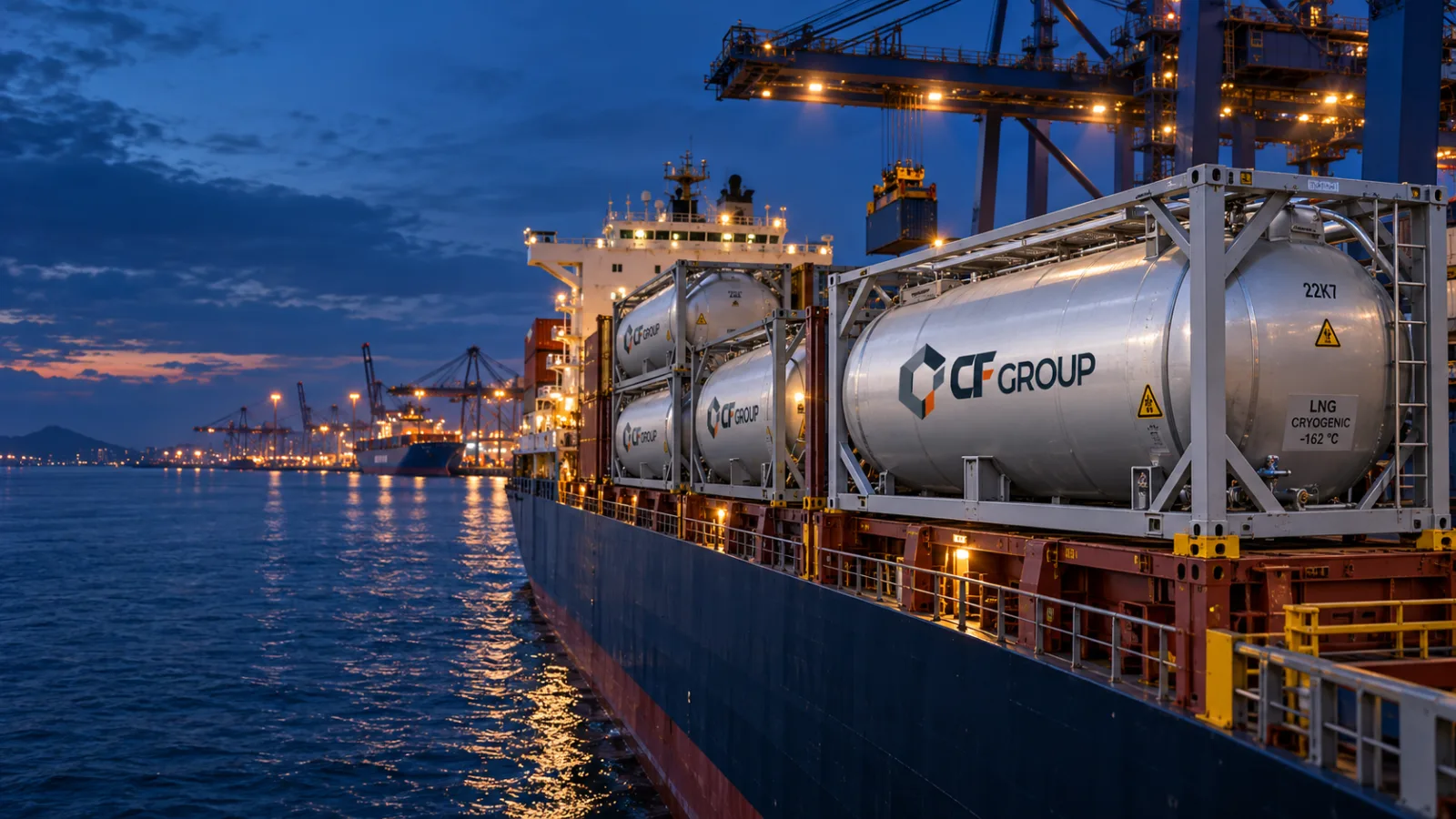
ISO T75s loaded on container feeder vessels on the Cai Mep – Hai Phong route, extending to Da Nang and Vung Ang, under IMDG Class 2.1 dangerous-goods procedures.
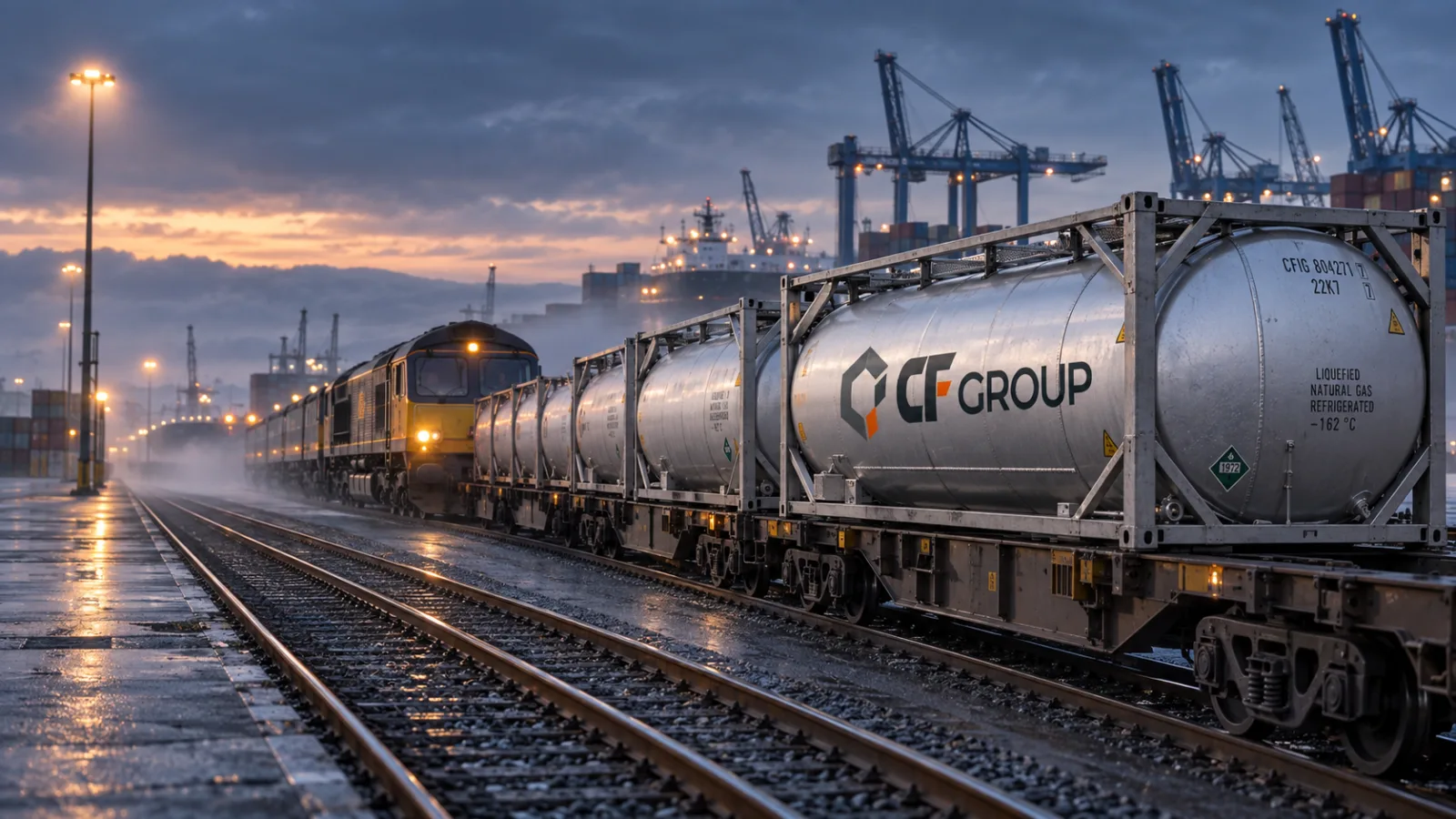
ISO T75s on flat wagons along the North–South railway, a complementary and backup mode when weather or sailing schedules disrupt the sea route.
Vietnam has a green-energy transition programme for transport (Decision 876/QĐ-TTg, 2022) and is drafting an emissions-reduction roadmap for its fleet. With ISO T75 tanks, a port network and a data platform already in place, CF Energy takes LNG one leg further: from plant to quayside, metered.
High-power vessels on long trips, with fuel the biggest cost of every voyage. The workable route is to keep the diesel engine and add an LNG dual-fuel system — which needs LNG supply right at the fishing-port cluster.
Short routes, fixed schedules, back in port every night, operating in bays that need to stay clean — a natural fit for LNG: one bunkering point serves the whole fleet.
North–South and river–sea routes have fixed end points, so LNG bunkering at both ends is enough. Works alongside Nam Duong's barge and river–sea fleet in the ecosystem.
CF Energy is looking for pilot partners port cluster by port cluster. CF Energy covers supply, bunkering, engineering and data; on-board design and installation is done by technology partners and certified yards under registry rules. Related policy: Decision 876/QD-TTg of 22 July 2022. Read the marine LNG page (Vietnamese) →
Typical ranges from ISO tank manufacturers’ technical documentation; the exact configuration for each contract is fixed after the site survey.
| Container size | 40 ft (common) · 20 ft |
| Net capacity, 40 ft | ≈ 44 000 – 47 000 L |
| Max. allowable working pressure (MAWP) | 7.6 – 10 bar by design |
| Inner vessel design temperature | −196 °C to +50 °C |
| Insulation | Multi-layer vacuum, double shell |
| Reference holding time | Tens of days before venting |
| Tare / max. gross | ≈ 12.5 – 13.2 t / 36 t |
| Dangerous goods | IMDG Class 2.1 (LNG) · 2.2 (inert) |
| Container size | 20 ft (common) · 40 ft |
| Net capacity | ≈ 24 000 – 29 000 L |
| Principle | Single-shell pressure vessel, no cryogenic insulation |
| Design temperature | −40 °C to +55 °C |
| Build standard | UN Portable Tank · ASME |
| Dangerous goods | IMDG Class 2.1 (LPG) · 2.3 (NH₃) |
| Use | Bulk LPG at plant, export ISO, pressurised chemical gases |
| Shared with T75 | Chassis, depot, HSSE procedures, GasTwin™ |
| Equipment | Tube trailer, 20 ft / 40 ft skid with pressure tubes |
| Working pressure | 200 – 250 bar |
| Reference gas volume | ≈ 5 800 – 12 000 Nm³ per trailer by tube count |
| Tube material | Alloy steel, or Type 4 composite up to 65 % lighter |
| Operating model | Mother station → trailer → pressure-reduction unit at customer |
| Dangerous goods | IMDG / ADR Class 2.1 |
| Best for | Plants near a mother station, mid-size demand, no pipeline |
| Shared with T75/T50 | Tractor fleet, telemetry, HSSE, GasTwin™ |
Sources: Chart Industries — ISO Containers · EXSIF T75 datasheet · EXSIF T50 datasheet · Danteco T50 · CIMC Enric CNG tube skids. Figures vary by manufacturer and build year.
Multimodal LNG in ISO tanks has already been done in Vietnam. The milestones below were announced by companies and the press; CF Energy builds on that infrastructure and precedent.
The Thi Vai LNG terminal starts shipping LNG in ISO tanks by truck to the South and South-Central regions — the road leg is commercially live.
Source: Nhan Dan ↗Vietnam’s first rail LNG shipment ran as a road–rail multimodal pilot, with 60–120 ISO tanks per month planned through late 2024.
Source: Bao Xay Dung ↗The Thi Vai terminal announces its expansion, due in 2026 — more supply for ISO routes to the North and Centre.
Source: Nha Dau Tu ↗Each step states what data is needed, what must be decided and which documents are handed over before moving on — so neither side's engineers have to guess.
Product, SDS, volume, delivery point and start date.
Output · Input data briefAccess, tank location, vehicle flow and plant interface.
Output · Survey recordEquipment, swap cycle, regasification and safety requirements.
Output · Technical proposalInterlock tests, coordination guide and abnormal scenarios.
Output · Acceptance fileStatus tracking, swap plan and maintenance schedule.
Output · Operating reportGasTwin™ brings every tank's documents, location, sensors and operating schedule into one place — whoever owns the tank.
Depots at both ends, South and North, plus technicians at the plant keep tanks turning fast and supply steady.
Next to the deep-water port; ISO depot and cleaning station for chemical and industrial-gas tanks.
Northern end of the coastal route; receives tanks from ships and distributes to the North and Centre.
Satellite tank and vaporiser skid at the plant; a regional technician comes for scheduled maintenance.
Beyond core gas logistics: CF Energy also operates two on-site energy services under long-term contracts — SolarFlow™ rooftop solar and SteamFlow™ biomass industrial steam. These are not the focus of this page; contact us if you need details.
 Smart.
CF Group grew from an investment company into a technology and industrial-services group, aiming for cargo that moves more automatically, more efficiently and visibly in real time. CF Energy is the gas and energy logistics part of that direction.
Installation, repair and operation of port handling equipment; bulk terminals up to 300 000 DWT and container terminals; 10+ years, 400+ staff.
→ ISO tank handling at both ports, depot landReal-time monitoring with AI and IoT; 500+ projects, 62 customers in 8 countries, 2 algorithm patents.
→ Builds and runs the GasTwin™ platformAGVs, AMRs, autonomous forklifts and control platforms for factories, warehouses, ports; 10+ years, 1 000+ projects.
→ Automated equipment movement inside depotsIndustrial land and park utilities — power, water, wastewater; built-to-suit workshops and warehouses.
→ Land and utilities for ISO depotsNon-flammable lithium iron phosphate batteries to US military industrial standards; 440 MWh cell capacity targeted for 2026.
→ BESS for SolarFlow™, backup power at customer stationsTechnical services for wind power — CF Group investment since 2023.
→ Field HSSE and heavy-equipment operating experienceInland waterway transport, container barges and connections between ports and ICDs in the north.
→ ISO tank connections by waterway between port, ICD and depotPlanning, design and review of logistics facilities, warehouses, depots and industrial infrastructure.
→ ISO depot layout, technical stations and infrastructure interfacesAutomated warehouses, cold chain and integrated logistics for industrial and condition-controlled cargo.
→ Transit warehousing, AS/RS and cargo coordination around ISO depotsMember figures per cfg.vn (About, Technology, Industrial Services). Inter-company services are contracted at market rates.
Learn about CF Group at cfg.vn ↗Three things CF Energy has because it sits inside CF Group — with a question to test your current supplier.
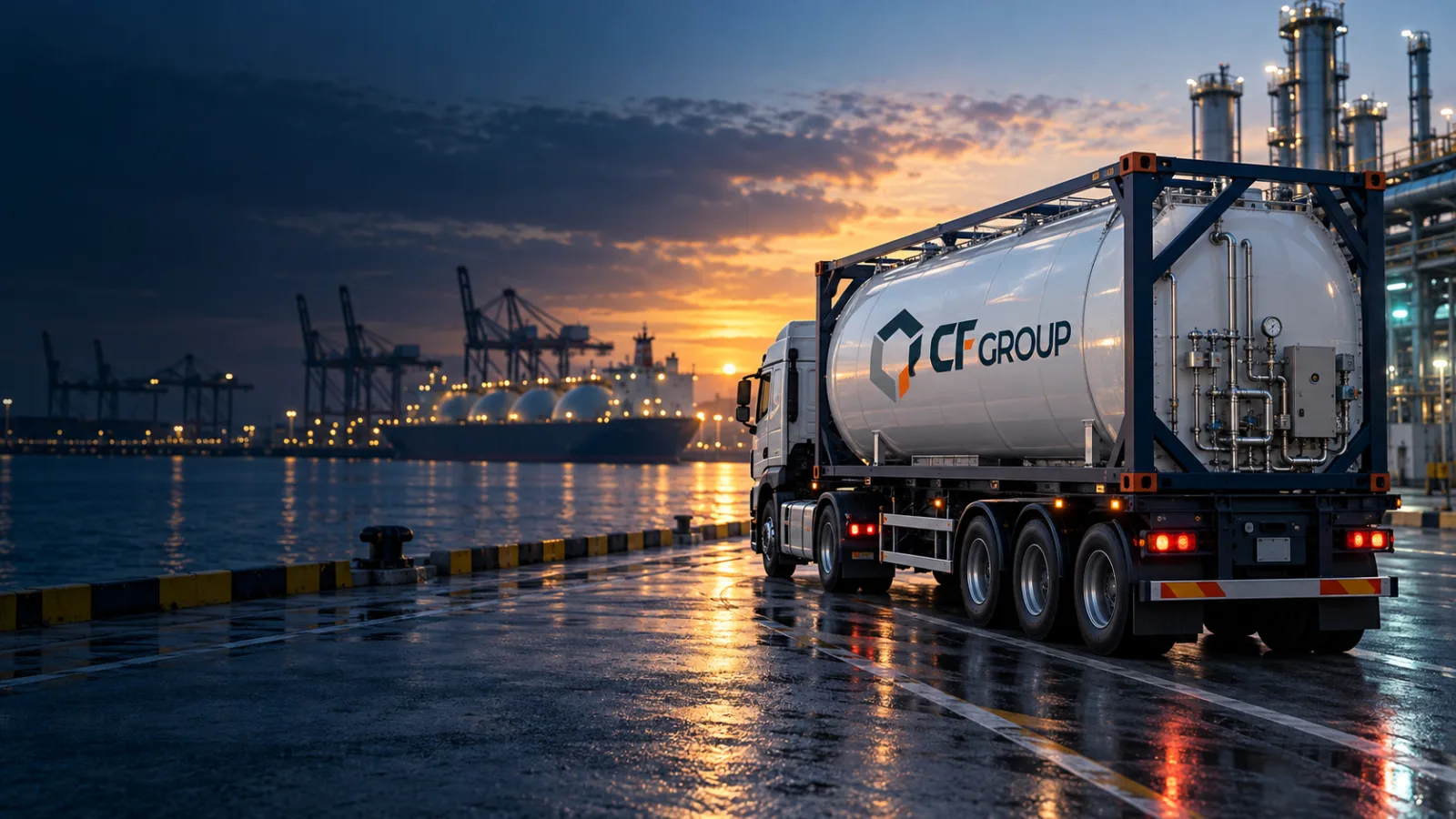
Two ports, one handling operator — why it is hard to copy.
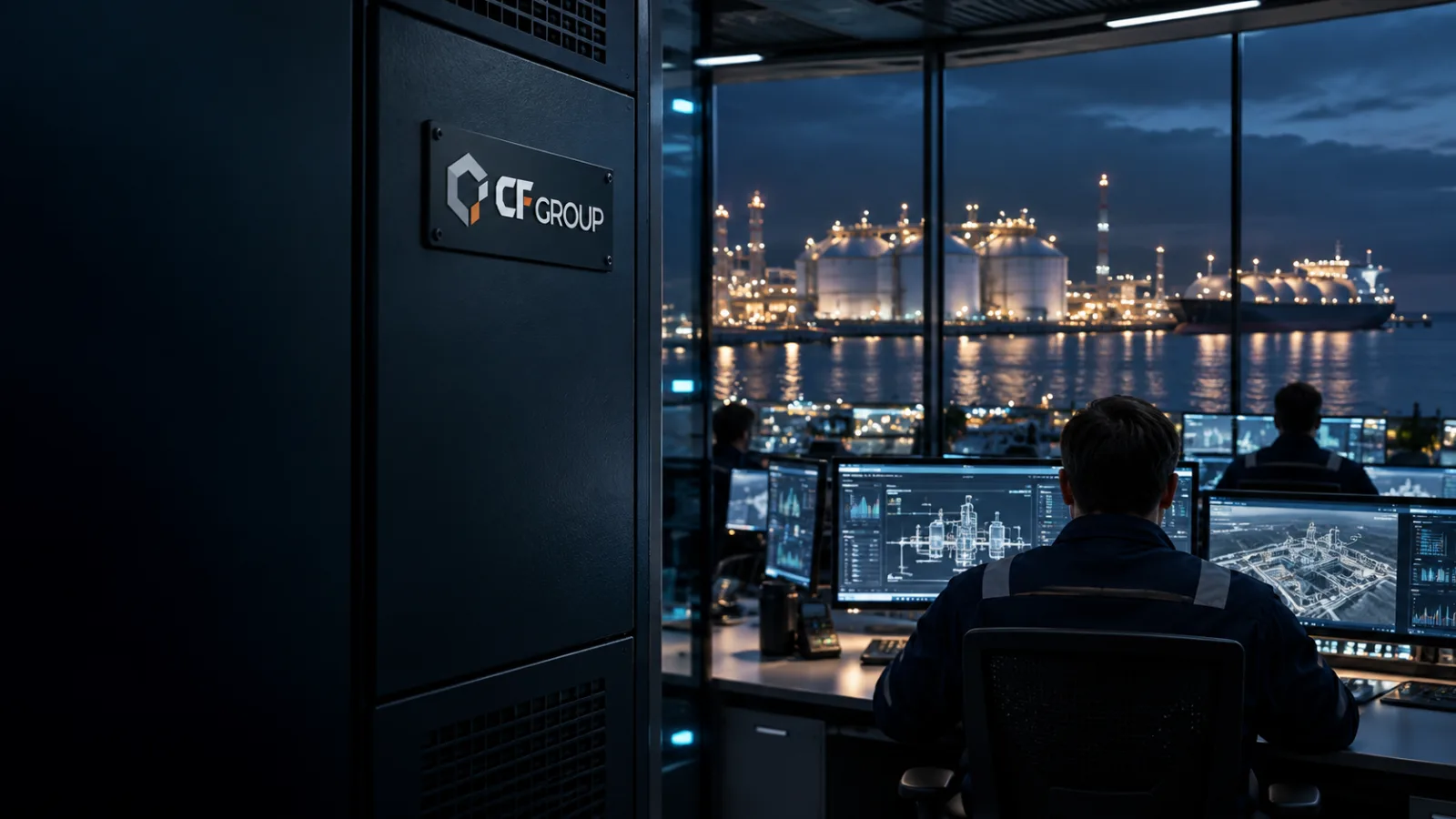
You do not need to own the tanks, only to have every tank report to one platform.
Not selling gas means CF Energy can carry for every cargo owner, even two competitors.
The questions engineering and procurement teams ask most often.
T75 tanks are vacuum-insulated, so boil-off is slow; reference holding times are measured in tens of days. In practice GasTwin™ tracks pressure and level to schedule the swap before the threshold, so the customer does not have to watch it.
A hard-standing for the tank and tractor access, a location for the regas skid, a tie-in to the existing gas system, and fire-safety documentation. CF Energy surveys the site and hands over a survey record before the configuration is fixed.
No. CF Energy only transports, leases equipment and operates it. The gas belongs to the cargo owner; CF Energy charges per tonne, per equipment-month or under an operating contract.
An ISO tank is an international standard unit: the same tank travels by road, sea and rail without transloading, loads onto feeder vessels and flat wagons, and can stand as temporary storage at the plant.
Yes. In September 2024 the first train carried 16 LNG ISO tanks south to north under a road–rail model, reported by the press and the railway operator. CF Energy treats rail as a complementary mode to the sea route.
The IMDG Code, dangerous goods Class 2.1: on-deck stowage, segregation, remote pressure monitoring and pre-loading declarations. Procedures are designed with port partners and the feeder line.
Never. Chemicals and food-grade liquids use separate tanks, cleaning lines and yards; food-grade tanks are cleaned and certified to food standards before every loading.
Yes. CF Energy brings LNG by ISO T75 to fishing-port clusters, tour piers and coastal ports, organises bunkering, safety surveys and per-trip MRV data. Vessel retrofit design and installation are done by technology partners under class rules. CF Energy does not sell gas; see the marine LNG page (Vietnamese).
CNG suits mid-size plants within a mother station’s radius and without a pipeline; equipment is simpler, with no regasification. LNG suits large demand or long distance because one ISO T75 carries many times the energy of a tube trailer. CF Energy advises on actual volume and location.
Answer five questions. The tool tells you which step to start from.
NO DATA COLLECTED · RESULT COMPUTED ON YOUR DEVICE
Just a few initial details. CF Energy will get back to you to clarify equipment, route and safety requirements.
Download company profile (PDF) ↓
View the technical checklist online →